
Should Kids Still Learn to Code in the age of AI? An Honest Answer
Should kids still learn to code in the age of AI? AI can write code in seconds, but your child needs one skill it can't replace — the honest 2026-27 answer.
6/30/20264 min read
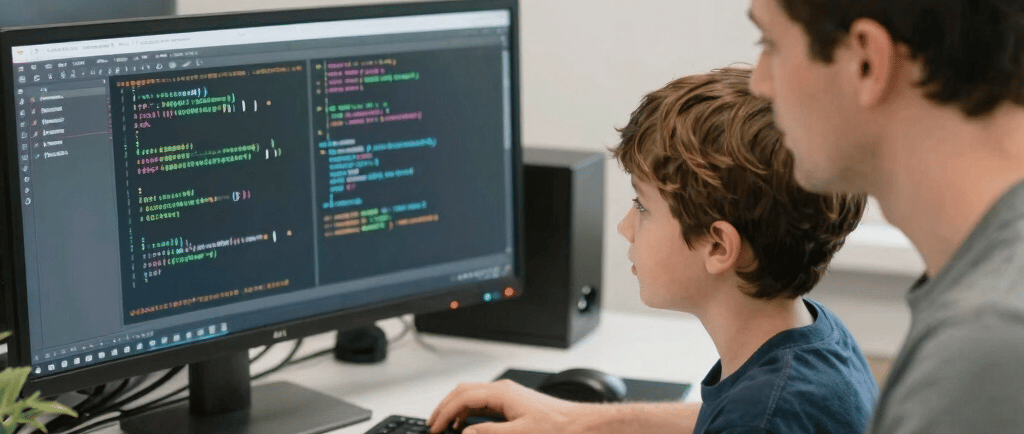
Should Kids Still Learn to Code Now That AI Can Write It? An Honest Answer for 2026
It's a fair question, and it's coming up in nearly every parenting group and school WhatsApp chain right now: if you can type a sentence into ChatGPT and get working code back in seconds, why should a 12-year-old spend years learning to code the hard way?
Here's the honest answer: the reason to learn coding has genuinely shifted. But the case for learning it is stronger now, not weaker — and the shift matters for what you should actually be buying your child, not just whether to buy anything at all.
What AI Actually Changed
Two years ago, AI tools were a smarter autocomplete — finishing a line of code you'd already started. Today, tools can generate an entire working app from a plain-English description, a trend now commonly called "vibe coding." That's a real and significant shift. It means the bottleneck in building software is no longer "can I type the syntax" — it's "can I tell, quickly and correctly, whether what got generated is actually right."
That second skill doesn't come from prompting. It comes from having built things by hand often enough to recognise what "right" looks like.
The Skill That Actually Matters Now: Knowing When AI Is Wrong
AI-generated code looks confident whether it's correct or not. It can be cleanly formatted, well-commented, and completely broken — a subtle logic error, a security hole, a wrong assumption buried three steps deep. A child who has never written or debugged code themselves has no way to catch that. They either trust it blindly or get stuck the moment something breaks, with no idea where to even start looking.
A child who has spent time actually writing code develops a different instinct entirely: reading an error message instead of panicking at it, forming a guess about what went wrong, testing that guess, and narrowing it down. That instinct is what turns "I used AI to build something" into "I built something, and I used AI to go faster." It's the difference between directing the work and hoping the work turns out fine.
This Isn't a Reason to Skip AI — It's a Reason to Teach Both Together
The old advice — "learn to code the traditional way, worry about AI later" — is already outdated. The better approach is teaching kids to build with AI from the point where they have enough fundamentals to actually direct it, rather than pretending AI doesn't exist until college.
That's exactly the structure MasterLeap Tutor's Code & AI Explorer curriculum follows. Grades 6 through 8 build the real fundamentals first — Python, data structures, how programs are actually built and debugged — the same hard-won cognitive habits every source on this topic agrees still matter: breaking a problem into pieces, being suspicious of output until it's verified, understanding what a system is doing even when you didn't write every line yourself.
Then, starting in Grade 9, a dedicated chapter — Building Apps WITH AI: A Practical Workflow — teaches students to use AI tools as a genuine development partner: planning a project properly, working alongside AI to build it, and understanding every piece of what gets produced instead of copying it blindly. By Grade 10, that becomes an entire capstone: a full-stack, AI-powered application, built by a student who understands both how to code and how to work with AI that codes.
That sequencing is deliberate. Skip the fundamentals and a child becomes purely a prompter — capable of asking, but not of judging the answer. Skip the AI-fluency layer and a child graduates knowing how to code the way it was done five years ago, not the way it's actually done now. Code & AI Explorer is built so neither gap opens up.
What This Looks Like in Practice
A student who has been through Grade 6–8 of the curriculum can open a Python file, read an error, and fix it. A student who continues into Grade 9–10 can also open an AI coding tool, describe what they want built, and — critically — evaluate whether what comes back is actually correct, secure, and worth shipping. That second skill is the one almost no one is teaching at school level in India yet, which is precisely why it's worth building on purpose rather than hoping it develops by accident.
Frequently Asked Questions
Won't AI just make coding skills obsolete by the time my child grows up? Every major wave of automation in computing — compilers, calculators, spreadsheets, low-code tools — was predicted to make the underlying skill obsolete, and each time it instead raised what "skilled" meant. AI is very likely to follow the same pattern: it raises the floor for what a non-coder can produce, while raising the ceiling for what someone who actually understands the system can do with it.
My child already uses ChatGPT constantly. Isn't that enough exposure to AI? Using a chatbot teaches prompting, not building. It doesn't teach a child to read what's actually happening inside the response, catch when it's wrong, or combine it with real logic to build something reliable. That gap is exactly what a structured curriculum closes.
At what age should this "AI as a development partner" piece start? Not before the fundamentals are in place. In Code & AI Explorer, that's why AI-assisted development is introduced from Grade 9 onward — after three years of building real programming and problem-solving skills, not before. In Grades 6 - 8, the focus is on understanding the basics of AI.
Give Your Child Both Halves of the Skill
The kids who do well over the next decade won't be the ones who can only prompt, or the ones who can only code the old-fashioned way. They'll be the ones who can do both — and know which one the moment calls for.
See the full Code & AI Explorer curriculum, Grades 6–10 here
Related Articles
Computer Science and AI course for grades 6 to 10 students in India